A 12 V domestic solar systemSistema solar doméstico de 12 V
A small solar power system, explained part by part. See how it connects, what happens by day and by night, how much it can power and what each component does.Un sistema pequeño de energía solar, explicado pieza por pieza. Mira cómo se conecta, qué ocurre de día y de noche, cuánto puede alimentar y qué hace cada componente.
Swap day for night, switch on the lamp, the phone and the radio, and watch how the voltage, the current and the power respond in each cable. Figures 2 and 3, the two graphs along the bottom of the same frame, show two signals you would normally only see on an oscilloscope: the pulses the controller charges the battery with, and the wave the inverter makes.Cambia el día por la noche, enciende el foco, el teléfono y la radio, y mira cómo responden el voltaje, la corriente y la potencia en cada cable. Las figuras 2 y 3, las dos gráficas al pie del mismo cuadro, muestran dos señales que normalmente solo se ven con un osciloscopio: los pulsos con los que el regulador carga la batería y la onda que fabrica el inversor.
Condition:Condición:Loads:Cargas:
Fig. 1. The whole kit in motion. The two graphs along the bottom of the frame are figs. 2 (the controller's pulses, left) and 3 (the inverter's wave, right).Fig. 1. El kit completo en movimiento. Las dos gráficas al pie del cuadro son las figs. 2 (los pulsos del regulador, izquierda) y 3 (la onda del inversor, derecha).
3How far does it go?¿Para cuánto alcanza?
powerpotencia = how much can be used at the same timecuánto se puede usar al mismo tiempo
The inverter sets this limit. Lamp, phone and radio together ask for about 35 W, a tenth of it.El límite lo pone el inversor. Foco, teléfono y radio juntos piden unos 35 W, una décima parte.
300 W
energyenergía = for how long it can be useddurante cuánto tiempo se puede usar
The battery sets this limit: half of its 216 Wh is a night's healthy budget.El límite lo pone la batería: la mitad de sus 216 Wh es el presupuesto sano de una noche.
108 Wh
This is a small system, meant for lights, phones, radios and similar small devices. It does not run fridges, irons, blenders or large tools.Es un sistema pequeño, pensado para luces, teléfonos, radios y aparatos parecidos. No alimenta refrigeradores, planchas, licuadoras ni herramientas grandes.
The kit works in two halves. By day the panel produces electricity: it can be used directly (the controller's USB ports) while the battery charges. By night the battery returns what it stored: one or two lamps through the evening, two or three phones and the radio.El kit trabaja en dos tiempos. De día, el panel produce electricidad: puede usarse directamente (los puertos USB del regulador) mientras la batería se carga. De noche, la batería devuelve lo que almacenó: uno o dos focos durante la velada, dos o tres teléfonos y la radio.
The kit's cycle: by day the panel charges the battery; by night the battery supplies the house.El ciclo del kit: de día el panel carga la batería; de noche la batería alimenta la casa.
In numbers. With about four hours of good sun, the 60 W panel produces around 240 Wh a day. A small fridge needs three times that. A 10 W LED lamp for six hours uses 60 Wh; charging two phones, about 30 Wh; the radio for two hours, another 30 Wh. All of it fits within one day's production.En números. Con unas 4 horas de buen sol, el panel de 60 W produce alrededor de 240 Wh al día. Un refrigerador pequeño necesita el triple. Un foco LED de 10 W durante seis horas consume 60 Wh; cargar dos teléfonos, unos 30 Wh; la radio dos horas, otros 30 Wh. Todo cabe en la producción de un día.
The bar fills with the day's production and is then divided between the lamp, the phones and the radio. About half remains.La barra se llena con la producción del día y luego se reparte entre el foco, los teléfonos y la radio. Sobra alrededor de la mitad.
Two limits: power and energyDos límites: potencia y energía
The first limit is how much can be on at the same time, and the inverter sets it: 300 W. Lamp, phone and radio together draw 35 W, a tenth of that.El primer límite es cuánto puede estar encendido al mismo tiempo, y lo pone el inversor: 300 W. Foco, teléfono y radio juntos consumen 35 W, la décima parte.
The second is for how long, and the stored energy sets it: about 108 Wh a night (half of the battery's 216 Wh, concept 7.5). With all three on, 35 W, that budget lasts about three hours; with the lamp alone, about ten.El segundo es por cuánto tiempo, y lo pone la energía almacenada: unos 108 Wh por noche (la mitad de los 216 Wh de la batería, concepto 7.5). Con los tres aparatos encendidos, 35 W, ese presupuesto dura unas 3 horas; solo con el foco, unas 10.
The battery as a tank and the loads as outlets: the same night's budget with three loads or with one. The counter shows the hours.La batería como tanque y las cargas como salidas: el mismo presupuesto de una noche con tres cargas o con una. El contador muestra las horas.
4The partsLas piezas
The parts of the kit and what the figures on their labels mean.Las piezas del kit y lo que significan los datos de sus etiquetas.
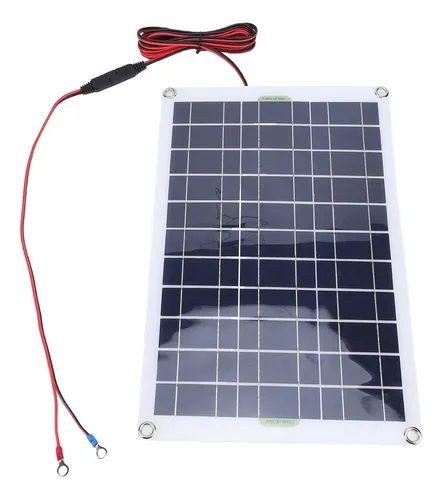
Photovoltaic panel · 60 WPanel fotovoltaico · 60 W
4.1
Solar panelPanel solar
60 W · 12 V
Turns sunlight into direct current.Convierte la luz del sol en corriente continua.
In more depthMás a fondo
The label says 60 W and 12 V. The 60 watts are the most the panel delivers in full sun: energy per second. The "12 V" is its category, not its working voltage. It means "designed to charge 12 volt batteries", which is the standard for small systems.La etiqueta dice 60 W y 12 V. Los 60 watts son la potencia máxima que el panel entrega a pleno sol: energía por segundo. El "12 V" es su categoría, no su voltaje de trabajo: significa "diseñado para cargar baterías de 12 voltios", que es el estándar de los sistemas pequeños.
In operation the panel produces around 18 volts, and that margin is necessary. To push current into a battery you have to beat the battery's own voltage, which rises to 14.4 V while charging. The panel also loses voltage when it gets hot or when a cloud passes. The 18 V margin allows it to charge even in weak light.En operación el panel produce unos 18 voltios, y ese margen es necesario. Para meter corriente en una batería hay que superar el voltaje de la batería, que durante la carga sube hasta 14,4 V. Además, el panel pierde voltaje cuando se calienta o cuando pasa una nube. El margen de 18 V permite que cargue incluso con poca luz.
The sun crosses a whole day. The watts rise and fall with the light; the voltage stays near 18 V for as long as there is sun.El sol recorre su día completo. Los watts suben y bajan con la luz; el voltaje se queda cerca de 18 V mientras haya sol.
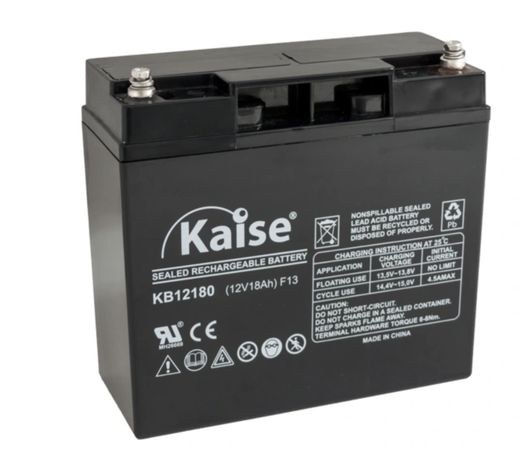
AGM battery · 12 V · 18 AhBatería AGM · 12 V · 18 Ah
4.2
AGM batteryBatería AGM
12 V · 18 Ah · 216 Wh
Stores the day's energy for use at night.Guarda la energía del día para usarla de noche.
In more depthMás a fondo
It stores energy in chemical form. Its label says 18 Ah: it can give 18 amps for one hour, or 1 amp for eighteen hours. Multiplied by its 12 V, that is 216 Wh of stored energy.Almacena la energía en forma química. Su etiqueta dice 18 Ah: puede entregar 18 amperios durante una hora, o 1 amperio durante 18 horas. Multiplicado por sus 12 V, son 216 Wh de energía almacenada.
It is an AGM type: the acid is held in glass fibre and the case is sealed. It does not spill, it does not give off gas in normal use and it needs no maintenance, so it can be installed indoors. The main rule: do not discharge it below half (concept 7.5).Es de tipo AGM: el ácido está absorbido en fibra de vidrio y la caja va sellada. No se derrama, no suelta gases en uso normal y no pide mantenimiento, por eso puede instalarse dentro de la casa. La regla principal: no descargarla más de la mitad (concepto 7.5).
A whole day in a few seconds. The battery rises with the sun and falls with use; the red line marks 50 %.Un día completo en unos segundos. La batería sube con el sol y baja con el uso; la línea roja marca el 50 %.
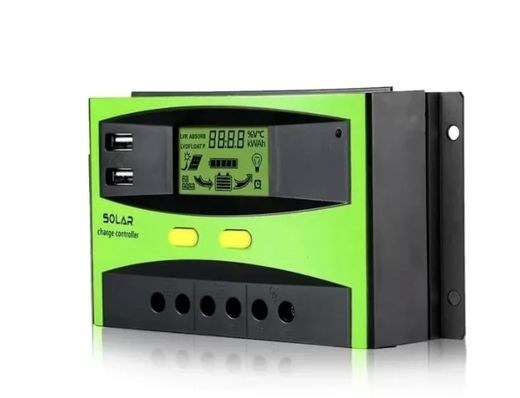
Charge controller · PWM · 10 ARegulador de carga · PWM · 10 A
4.3
PWM charge controllerRegulador PWM
10 A · 2 × USB 5 V
Governs the battery's charging and gives 5 V over USB.Controla la carga de la batería y entrega 5 V por USB.
In more depthMás a fondo
It sits between the panel and the battery and regulates the current that passes. It does that by cutting the flow into pulses, hundreds of times a second: that technique is the PWM on its label, and the left hand graph at the bottom of the system diagram (fig. 2) shows it live. Its screen reports the battery voltage, the most direct indicator of the system's state.Está entre el panel y la batería y regula la corriente que pasa. Lo hace cortando el flujo en pulsos, cientos de veces por segundo: esa técnica es el PWM de su etiqueta, y la gráfica de la izquierda al pie del diagrama del sistema (fig. 2) la muestra en vivo. Su pantalla indica el voltaje de la batería, el indicador más directo del estado del sistema.
The two USB ports give 5 V directly. For charging phones they are the most efficient option: the inverter stays off and nothing is lost in conversion. The 10 A on the label is the most current it can take, three times what this panel gives. It works well below its limit, which extends its life.Los dos puertos USB entregan 5 V directamente. Para cargar teléfonos son la opción más eficiente: el inversor queda apagado y no se pierde energía en la conversión. El 10 A de la etiqueta es la corriente máxima que soporta, el triple de lo que da este panel. Trabaja lejos de su límite, lo que alarga su vida útil.
The controller feeds two paths at once. Pulses of 12 V to the battery (blue) and a steady 5 V to the phone (green).El regulador alimenta dos caminos a la vez. Pulsos de 12 V hacia la batería (azul) y 5 V continuos hacia el teléfono (verde).
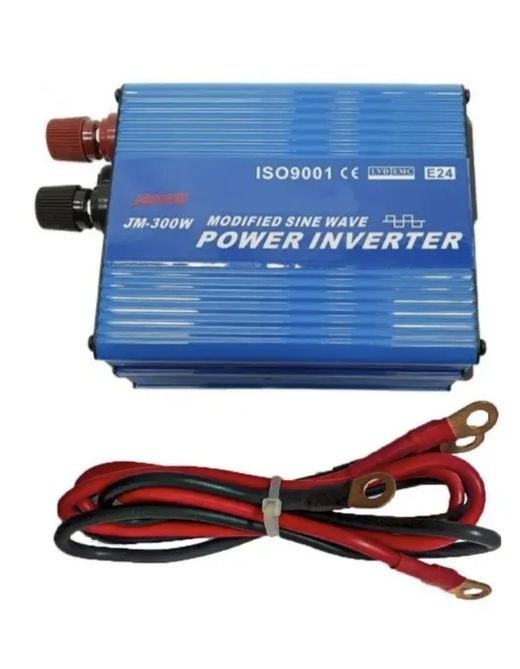
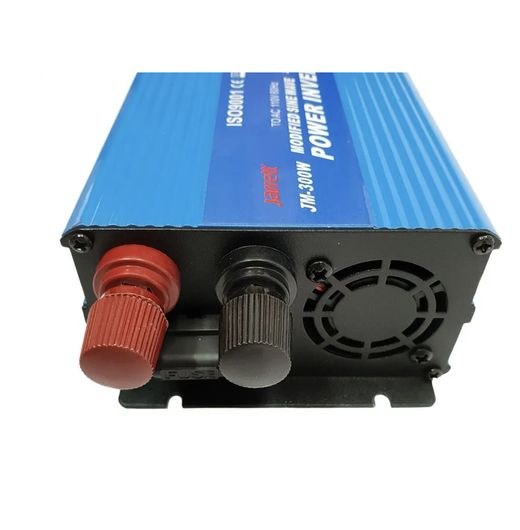
Inverter · 300 W · 12 V DC → 110 V ACInversor · 300 W · 12 V CC → 110 V CAInverter · seen from the back: terminals, fuse and fanInversor · vista posterior: bornes, fusible y ventilador
4.4
InverterInversor
300 W · 12 V CC → 110 V CA
Turns the battery's 12 V into 110 V alternating current.Convierte los 12 V de la batería en 110 V de corriente alterna.
In more depthMás a fondo
The frontPor delante
It turns the battery's 12 V of direct current into 110 V of alternating current, like the mains. Its 300 W is the limit of what it can run at once: lamps, chargers, a radio, a small television. An iron or a blender asks for far more than 300 W, and the inverter shuts down for protection.Convierte los 12 V de corriente continua de la batería en 110 V de corriente alterna, como los de la red. Sus 300 W son el límite de lo que puede alimentar a la vez: focos, cargadores, una radio, un televisor pequeño. Una plancha o una licuadora piden mucho más de 300 W, y el inversor se apaga por protección.
Its wave is a "modified sine", a stepped version of the mains wave. The right hand graph at the bottom of the system diagram (fig. 3) compares the two. For most household appliances the difference is irrelevant.Su onda es "senoidal modificada", una versión escalonada de la onda de la red. La gráfica de la derecha al pie del diagrama del sistema (fig. 3) compara las dos. Para la mayoría de los aparatos domésticos la diferencia es irrelevante.
The load rises past 300 W; the inverter shuts down for protection and restarts.La carga sube hasta superar los 300 W; el inversor se apaga por protección y reinicia.
The back: fuse, fan and terminalsPor detrás: fusible, ventilador y bornes
Its two protections are at the back. The fuse, beside the terminals, is a sacrificial part: if something is wired wrongly or asks for too much current, the fuse blows first and protects the device. Replace it with one of the same rating and the inverter works again. The fan takes away the heat the conversion makes.Por detrás están sus dos protecciones. El fusible, junto a los bornes, es una pieza de sacrificio: si algo se conecta mal o pide demasiada corriente, el fusible se funde primero y protege al aparato. Se sustituye por otro del mismo valor y el inversor vuelve a funcionar. El ventilador saca el calor que produce la conversión.
The red and black terminals go straight to the battery, on short thick cables. The reason is concept 7.6: at 12 V the currents are large, and long or thin cables dissipate energy as heat.Los bornes rojo y negro van directo a la batería, con cables cortos y gruesos. La razón está en el concepto 7.6: a 12 V las corrientes son grandes, y los cables largos o delgados disipan energía en forma de calor.
Normal operation; then an overcurrent blows the fuse and the circuit opens.Operación normal; después una sobrecorriente funde el fusible y el circuito se abre.
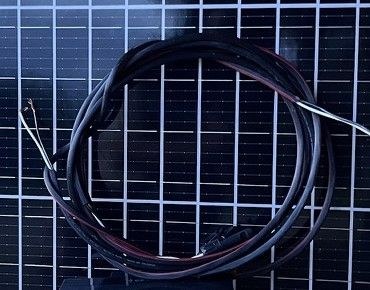
Cables and MC4 connectorsCables y conectores MC4
4.5
Cables and MC4 connectorsCables y conectores MC4
MC4 · weatherproofa la intemperie
Join the panel to the controller and only go in one way.Unen el panel con el regulador y solo entran de una manera.
In more depthMás a fondo
The panel's MC4 connectors are made for the weather: they click together, seal against rain, and do not come apart if you pull them. Positive and negative are different shapes, so they cannot be connected the wrong way round.Los conectores MC4 del panel están diseñados para la intemperie: encajan con un clic, quedan sellados contra la lluvia y no se sueltan tirando de ellos. El positivo y el negativo tienen formas distintas, de modo que no pueden conectarse al revés.
The rest of the wiring follows one rule: the more current a run carries, the shorter and thicker the cable has to be. The critical run is the one between the battery and the inverter.El resto del cableado sigue una sola regla: entre más corriente lleva un tramo, más corto y más grueso debe ser el cable. El tramo crítico es el que une la batería con el inversor.
Above, the connector engages and seals. Below, reversed, it does not engage.Arriba, el conector encaja y queda sellado. Abajo, invertido, no encaja.
5How it fits togetherCómo se arma
The same parts as above, in the order they connect. It is an overview, not an installation guide.Las mismas piezas de arriba, puestas en el orden en que se conectan. Es una vista de conjunto, no una guía de instalación.
Solar panelPanel solar
60 W · ~18 V
↓Direct current, about 18 VCorriente continua, unos 18 V
Cable with MC4 connectorsCable con conectores MC4
+ / − · one way onlysolo entran de una manera
Charge controllerRegulador de carga
PWM · 10 A
↔Charging and dischargingCarga y descarga
BatteryBatería
12 V · 18 Ah
↓From the controller: 5 V USB for phones · from the battery: short, thick cables to the inverterDesde el regulador: USB 5 V para teléfonos · desde la batería: cables cortos y gruesos al inversor
InverterInversor
300 W · 12 V CC → 110 V CA
↓110 V alternating current110 V de corriente alterna
Compatible loadsCargas compatibles
LED lamp · 10 WFoco LED · 10 W
Phone · 10 W (better from the controller's USB)Teléfono · 10 W (mejor por USB del regulador)
Radio · 15 WRadio · 15 W
Before connectingAntes de conectar
This diagram shows which part goes with which. Before a real installation, check the polarity (red to red, black to black), the cable size for the current it carries, the protections (fuses or a breaker between battery and inverter) and the manuals of each component, above all on the 110 V side, where the voltage is already dangerous.Este esquema muestra qué pieza va con cuál. Antes de una instalación real hay que revisar la polaridad (rojo con rojo, negro con negro), el grosor de los cables según la corriente que llevan, las protecciones (fusibles o interruptor entre batería e inversor) y los manuales de cada componente, sobre todo en el lado de 110 V, donde el voltaje ya es peligroso.
By day. Sunlight does not produce electricity through heat. Each photon that enters the silicon can free an electron from its atom. The cell has an internal border, the p-n junction, which works like a one way ramp: it pushes every loose electron towards the same side. That ordered flow is the electric current. Figure 4 shows the process in motion. Each cell contributes half a volt; the panel wires 36 of them in series to gather about 18 V. The controller takes that current and hands it to the battery in pulses. In the pulse graph at the bottom of the system diagram (fig. 2), the fuller the battery, the shorter the pulses.De día. La luz del sol no genera electricidad por calor. Cada fotón que entra al silicio puede liberar un electrón de su átomo. La celda tiene una frontera interna, la unión p-n, que funciona como una rampa de un solo sentido: empuja a todos los electrones sueltos hacia el mismo lado. Ese flujo ordenado es la corriente eléctrica. La figura 4 muestra el proceso en movimiento. Cada celda aporta medio voltio; el panel conecta 36 en serie para juntar unos 18 V. El regulador recibe esa corriente y la entrega a la batería en pulsos. En la gráfica de pulsos al pie del diagrama del sistema (fig. 2), cuanto más llena está la batería, más cortos son los pulsos.
Fig. 4. Inside one cell of the panel: the photovoltaic effect, step by step.Fig. 4. Dentro de una celda del panel: el efecto fotovoltaico, paso por paso.
At night. Without light there are no free electrons and the panel produces nothing. The battery is still connected to the panel, so current could flow backwards and be lost heating the panel. To prevent that, the controller has a diode, which only lets current pass towards the battery. At night the inverter takes the battery's 12 V of direct current and turns it into 110 V of alternating current at 60 Hz, which is what ordinary appliances use. Every appliance switched on asks for more watts, and by the relation P = V × I, more watts mean more amps leaving the battery.De noche. Sin luz no hay electrones libres y el panel no produce. La batería sigue conectada al panel, así que la corriente podría regresar y perderse calentando el panel. Para evitarlo, el regulador tiene un diodo, que solo deja pasar la corriente hacia la batería. De noche el inversor toma los 12 V de corriente continua de la batería y los convierte en 110 V de corriente alterna a 60 Hz, que es lo que usan los aparatos comunes. Cada aparato encendido pide más watts, y por la relación P = V × I, más watts son más amperios saliendo de la batería.
At night the diode blocks the current returning to the panel; the path to the lamp stays open.De noche el diodo bloquea la corriente de regreso al panel; el camino hacia el foco sigue abierto.
7To understand it betterPara entenderlo mejor
Six concepts behind the kit's figures.Seis conceptos detrás de los números del kit.
7.1Volts, amps, wattsVoltios, amperios, watts
Voltage (V) is the force pushing electrons along the cable. Current (A) is how many electrons pass per second. Power (W) is what the two make together: P = V × I.El voltaje (V) es la fuerza que empuja los electrones por el cable. La corriente (A) es la cantidad de electrones que pasan por segundo. La potencia (W) es el resultado de las dos: P = V × I.
In this kit: the 60 W panel at 18 V gives up to 60 ÷ 18 ≈ 3.3 A. And when the inverter runs 35 W of appliances it draws about 3.4 A from the battery, almost the same current for half the power, because it works at only 12 V and loses a little in converting. The general rule: the lower the voltage, the more current for the same power.Con este kit: el panel de 60 W a 18 V entrega hasta 60 ÷ 18 ≈ 3,3 A. Y cuando el inversor alimenta 35 W de aparatos, saca unos 3,4 A de la batería, casi lo mismo para la mitad de potencia, porque trabaja a solo 12 V y pierde algo de energía al convertir. Regla general: a menor voltaje, más corriente para la misma potencia.
Both cables carry the same 35 W. Above, low current at high voltage; below, high current at low voltage.Los dos cables llevan los mismos 35 W. Arriba, poca corriente a alto voltaje; abajo, mucha corriente a bajo voltaje.
7.2Why cells give what they givePor qué las celdas dan lo que dan
Each solar cell produces about 0.5 V. It is a physical property of silicon, independent of the manufacturer: the energy it costs to free an electron in that material fixes the cell's voltage.Cada celda solar produce ~0,5 V. Es una propiedad física del silicio, independiente del fabricante: la energía que cuesta liberar un electrón en ese material fija el voltaje de la celda.
To get more voltage, cells are wired in series, one after another, and their voltages add up: 36 cells at 0.5 V give the panel's 18 V or so. A "24 V" panel has twice as many cells.Para conseguir más voltaje se conectan celdas en serie, una tras otra, y sus voltajes se suman: 36 celdas por 0,5 V dan los ~18 V del panel. Un panel "de 24 V" tiene el doble de celdas.
Each cell adds half a volt as the current passes, and the column on the right fills to 18 V.Cada celda suma medio voltio al pasar la corriente, y la columna de la derecha se llena hasta los 18 V.
7.3PWM: charging in pulsesPWM: cargar por pulsos
The controller protects the battery by governing how much current reaches it. It does that with an electronic switch (a transistor) that opens and closes the path hundreds of times a second. That is PWM, pulse width modulation. The battery receives the average of those pulses.El regulador protege la batería controlando cuánta corriente le entra. Lo hace con un interruptor electrónico (un transistor) que abre y cierra el paso cientos de veces por segundo. Eso es PWM, modulación por ancho de pulso. La batería recibe el promedio de esos pulsos.
Battery flat: long pulses, charging at full current. Battery nearly full: pulses getting shorter. Battery full: only small maintenance pulses. It charges quickly at the start and slowly at the end, without overheating the battery.Batería descargada: pulsos largos, carga a plena corriente. Batería casi llena: pulsos cada vez más cortos. Batería llena: solo pequeños pulsos de mantenimiento. Carga rápido al principio y lentamente al final, sin sobrecalentar la batería.
The switch opens and closes without stopping. The fuller the battery gets, the less time it spends closed.El interruptor se abre y se cierra sin parar. Cuanto más se llena la batería, menos tiempo pasa cerrado.
7.4DC → AC: what the inverter does insideCC → CA: qué hace el inversor por dentro
The battery gives direct current (DC): it always flows the same way. Ordinary appliances use alternating current (AC), which changes direction 60 times a second.La batería entrega corriente continua (CC): fluye siempre en el mismo sentido. Los aparatos comunes usan corriente alterna (CA), que cambia de sentido 60 veces por segundo.
The inverter converts in two steps: four transistors reverse the direction of the current 120 times a second, and a transformer lifts the voltage from 12 V to 110 V. The wave that comes out is stepped, not a smooth curve like the mains; the right hand graph at the bottom of the system diagram (fig. 3) shows the difference. It is adequate for lamps, chargers and radios; some motors and sensitive audio equipment are affected.El inversor convierte en dos pasos: cuatro transistores invierten el sentido de la corriente 120 veces por segundo, y un transformador sube el voltaje de 12 V a 110 V. La onda que sale es escalonada, no una curva suave como la de la red; la gráfica de la derecha al pie del diagrama del sistema (fig. 3) muestra la diferencia. Es adecuada para focos, cargadores y radios; algunos motores y equipos de audio sensibles sí se ven afectados.
The current reverses repeatedly (the + and − signs swap). On the right, the resulting wave.La corriente cambia de sentido repetidamente (los signos + y − se intercambian). A la derecha, la onda resultante.
7.5Amp-hours and the 50 % ruleAmperios-hora y la regla del 50 %
The battery holds 18 amp-hours at 12 V: 18 × 12 = 216 Wh. Inside it has lead plates in acid. As it discharges, lead sulphate forms on the plates; as it charges, that sulphate breaks down again.La batería guarda 18 amperios-hora a 12 V: 18 × 12 = 216 Wh. Por dentro tiene placas de plomo en ácido. Al descargarse se forma sulfato de plomo sobre las placas; al cargarse, ese sulfato se deshace.
If the discharge goes too deep the sulphate hardens and does not come back: the battery loses capacity permanently. Using only half the charge, about 108 Wh a night, extends its life from months to years. The voltage indicates the state of charge: 12.7 V at rest is close to full; 12.0 V is about half.Si la descarga es muy profunda, el sulfato se endurece y ya no se recupera: la batería pierde capacidad de forma permanente. Usar solo la mitad de la carga (~108 Wh por noche) alarga su vida de meses a años. El voltaje indica el estado de carga: 12,7 V en reposo ≈ llena; 12,0 V ≈ mitad.
Both batteries are used and recharged. The green one, discharged to half, recovers fully. The red one, discharged completely, loses capacity with every cycle.Las dos baterías se usan y se recargan. La verde, descargada hasta la mitad, se recupera por completo. La roja, descargada a fondo, pierde capacidad en cada ciclo.
7.6Losses in the cable: I²RPérdidas en el cable: I²R
Every cable warms a little as current passes, and that energy is lost. The loss grows with the square of the current: P = I² × R. Twice the current loses four times as much.Todo cable se calienta un poco al pasar corriente, y esa energía se pierde. La pérdida crece con el cuadrado de la corriente: P = I² × R. El doble de corriente pierde cuatro veces más.
In this system the 12 V side moves a lot of current (300 W at 12 V is 25 A), so the cables between battery and inverter have to be short and thick. The grid uses the same principle the other way round: it transmits at very high voltages so the current is small and little is lost on the way.En este sistema, la parte de 12 V mueve mucha corriente (300 W a 12 V son 25 A), así que los cables entre batería e inversor deben ser cortos y gruesos. La red eléctrica usa el mismo principio al revés: transmite a voltajes muy altos para que la corriente sea pequeña y se pierda poco en el camino.
The same current passes through both cables. The thin one dissipates heat, energy lost; the thick one loses almost nothing.Pasa la misma corriente por los dos cables. El delgado disipa calor (energía perdida); el grueso casi no pierde nada.
8What does it cost?¿Cuánto cuesta?
Approximate cost of this system in Colombia, at the prices of the purchase made for this kit.Costo aproximado de este sistema en Colombia, con los precios de la compra que se hizo para este kit.
Reference prices from this purchase. They vary by supplier, place and date. The conversions are approximate and exchange rates change.Precios de referencia de esta compra. Pueden variar según proveedor, lugar y fecha. Las conversiones son aproximadas y el tipo de cambio varía.